If your dog has been diagnosed with elbow dysplasia, chiropractic care may help reduce pain, address the compensation patterns developing throughout the rest of the body, and support a better quality of life alongside your veterinarian’s treatment plan. Elbow dysplasia is one of the most common orthopedic conditions in medium and large breed dogs, and the spinal consequences of living with front-end pain are significant and often overlooked. At Axiom Animal Chiropractic in Charlotte, NC, we work regularly with dogs managing elbow dysplasia, and addressing the structural secondary effects is a meaningful part of helping these dogs function more comfortably.
What Is Elbow Dysplasia?
Elbow dysplasia is an umbrella term for several developmental conditions affecting the elbow joint, including fragmented coronoid process, osteochondrosis dissecans, and ununited anconeal process. What these conditions share is that they involve abnormal development of the elbow joint, which leads to pain, inflammation, cartilage damage, and progressive joint degeneration over time.
It’s most common in large and giant breeds, with Labrador Retrievers, Golden Retrievers, German Shepherds, Rottweilers, and Bernese Mountain Dogs among those most frequently affected. Signs often appear in young dogs, sometimes as early as four to nine months, though some dogs don’t show obvious symptoms until the secondary arthritis that develops from untreated elbow dysplasia becomes significant in adulthood.
How Elbow Dysplasia Affects the Entire Spine
This is where chiropractic care becomes particularly relevant. When a dog has painful elbows, they don’t simply limp on the affected leg and leave the rest of the body unchanged. They redistribute their weight. They shift toward the rear end, reduce the load they’re placing through sore front limbs, and alter how they move to protect the painful area. That redistribution creates a cascade of secondary effects throughout the spine.
The thoracic and cervical spine absorb the altered forces from the changed front-end mechanics. The muscles along the neck and mid-back tighten to manage those forces, which creates vertebral subluxations in regions far from the elbow itself. A dog with elbow dysplasia in both front legs often develops significant cervical and thoracic restrictions that contribute to stiffness, head and neck pain, and reduced overall mobility that owners may not immediately connect to the elbow diagnosis.
The rear end compensates as well. As weight shifts backward, the lumbar spine and pelvis take on additional load, creating restrictions in those regions too. By the time a dog with significant elbow dysplasia is evaluated chiropractically, restrictions are often found at multiple levels of the spine, all of them driven by years of compensating around front-end pain.
Signs the Spine Is Involved Alongside Elbow Dysplasia
If your dog has been diagnosed with elbow dysplasia, watch for these signs that spinal restrictions may be adding to their discomfort:
- Stiffness in the neck or reluctance to turn the head fully in one direction
- A hunched posture or lowered head carriage beyond what the elbow alone would explain
- Sensitivity along the back or shoulders when touched during grooming or examination
- Rear-end stiffness or weakness that doesn’t match the primary front-end diagnosis
- Overall reluctance to move that seems greater than the elbow condition alone would cause
- Muscle tension visible or palpable along the topline or through the shoulders
- Behavioral changes like increased irritability or avoidance of certain handling
These signs point to a body that’s working hard to manage a primary structural problem, and chiropractic care directly addresses what that compensation is creating throughout the spine.
How Chiropractic Fits Into an Elbow Dysplasia Management Plan
Your veterinarian manages the elbow itself, whether through medical management, physical therapy, or surgical intervention depending on the severity and type of dysplasia present. Chiropractic doesn’t change what’s happening in the elbow joint. What it does is address the spinal consequences of living with that condition.
Many dogs with elbow dysplasia who add chiropractic to their management plan move more freely overall, show reduced stiffness through the neck and back, and seem more comfortable in their bodies than their primary diagnosis alone would suggest. That improvement isn’t coming from anything changing in the elbow. It’s coming from reducing the secondary restrictions that have been compounding their pain load.
We coordinate with your veterinarian and ask for your dog’s records before the first visit. If your dog has had or is planning surgery for their elbow dysplasia, we’ll time our approach appropriately and adapt our care to support recovery rather than interfere with it. Learn more about canine chiropractic care at Axiom Animal Chiropractic.
What a First Visit Looks Like for a Dog with Elbow Dysplasia
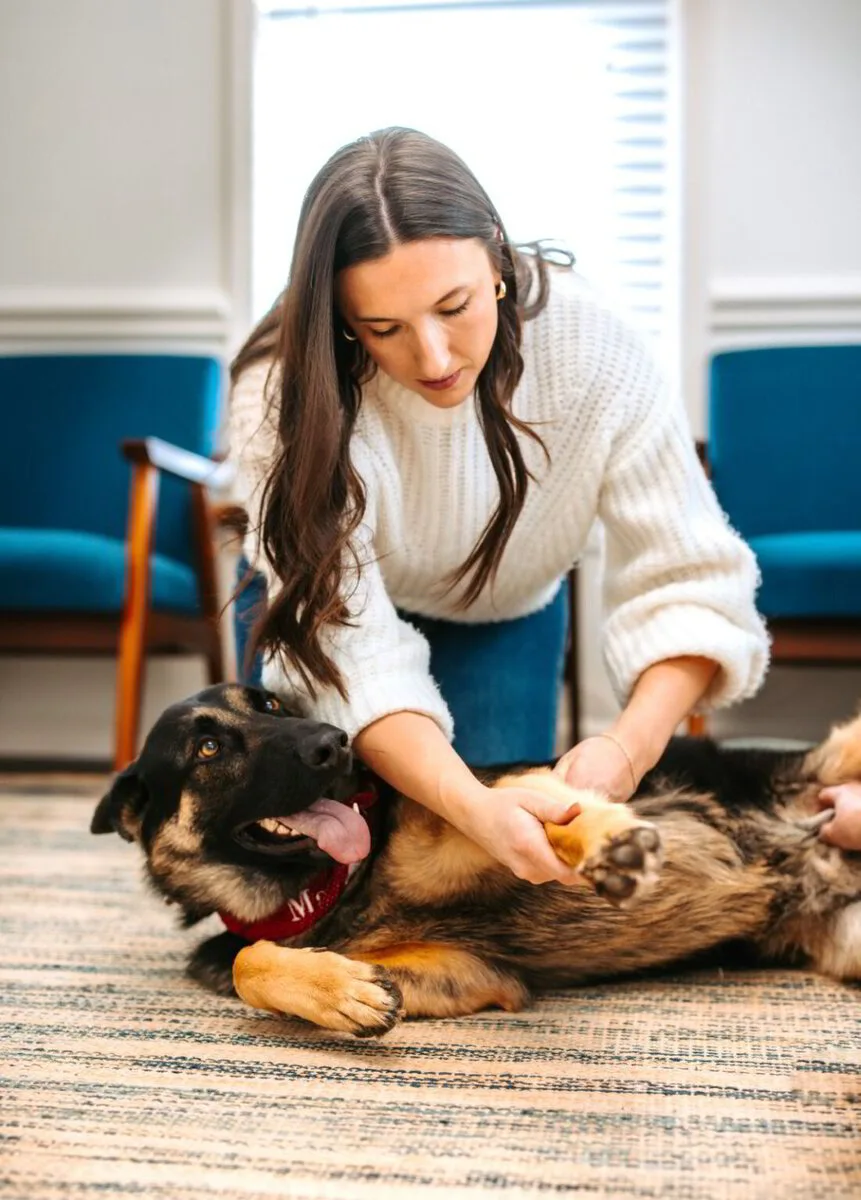
The first appointment begins with a review of your dog’s history, including their elbow dysplasia diagnosis, any imaging or surgical records, current medications, and what their activity level and daily life look like. From there, Dr. Megan evaluates posture and gait with particular attention to how the dog is weighting and moving through the front end and how that’s affecting the rest of the spine.
The hands-on evaluation identifies where subluxations are present and how significantly the compensation pattern has developed. Adjustments are adapted to what the dog can tolerate that day, taking into account any soreness in or around the affected limb. Dr. Megan works carefully with the dog’s comfort level throughout.
After the visit, you’ll receive home observation guidance and a recommended follow-up schedule. For dogs with active elbow dysplasia, an initial phase of more frequent visits is typically recommended to work through the accumulated restrictions before shifting to a maintenance schedule. Read about outcomes from dogs like yours on our testimonials page.
Serving Dogs with Elbow Dysplasia Across Charlotte, NC
Axiom Animal Chiropractic is located at 1726 E 7th St in Charlotte, NC. We see dogs from throughout the Charlotte metro area, including Huntersville, Concord, Mooresville, Gastonia, Matthews, and surrounding communities. Dr. Megan Hullihen is a Doctor of Chiropractic from Palmer College of Chiropractic with specialized animal chiropractic training and experience working with dogs managing a wide range of orthopedic conditions and the spinal consequences they create.
If your dog has elbow dysplasia and you want to explore what chiropractic care can add to their management plan, we’d be glad to help. Book at charlotteanimalchiropractor.com/contact or call us at (704) 469-4772.