
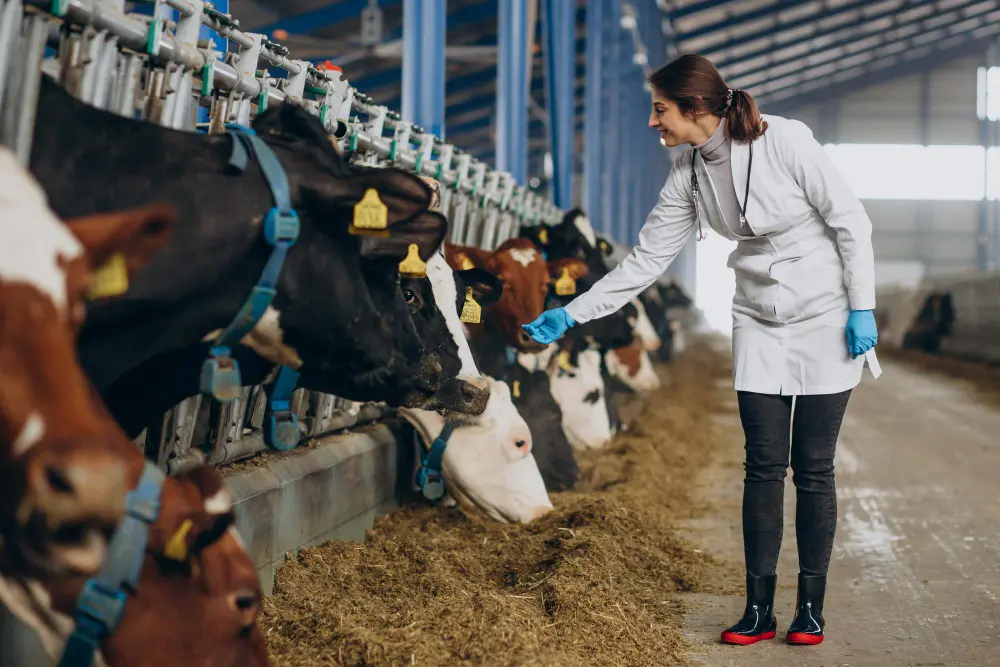
Livestock chiropractic care addresses spinal and joint restrictions in cattle, goats, sheep, and other farm animals that affect mobility, productivity, and overall herd health. It’s a service most farmers in the Charlotte area don’t know exists until they’ve exhausted other options, and it often delivers results that surprise even the most skeptical operators. At Axiom Animal Chiropractic, Dr. Megan Hullihen provides mobile livestock chiropractic care throughout the greater Charlotte, NC area, traveling directly to your farm so your animals never have to be hauled anywhere.
Why Livestock Spinal Health Matters More Than Most Farmers Realize
Farm animals work hard. Cattle, goats, and sheep spend their lives on their feet, often on uneven terrain, in varying weather conditions, and under the physical demands of breeding, birthing, and production cycles. That wear accumulates in the spine over time, and the resulting restrictions, called vertebral subluxations, affect far more than just how an animal moves.
The nervous system controls muscle coordination, organ function, immune response, and reproductive health. When subluxations disrupt normal nerve flow, the effects can show up as lameness, reduced productivity, difficulty during or after birthing, and behavioral changes that make handling harder. These are problems that farmers often manage around rather than address at the source, because most don’t realize a structural solution exists.
Chiropractic care corrects those subluxations, restores more normal nerve function, and gives the animal’s body a better environment to do what it’s designed to do.
Common Livestock Problems That Chiropractic May Help
Every farm and every animal is different, but there are patterns we see regularly in livestock that respond well to chiropractic care:
- Lameness that hasn’t fully resolved with standard veterinary treatment
- Difficulty rising, walking, or bearing weight evenly
- Complications during or after birthing, including difficulty in mares and does
- Reduced milk production or reproductive performance in dairy animals
- Unusual posture, such as a roached back or head held low
- Stress and handling difficulty that seems out of character for the animal
- Muscle asymmetry or tension visible along the topline
These aren’t always spinal problems, and we never suggest they are without a proper evaluation. But when standard approaches haven’t fully resolved the issue, spinal restrictions are often a contributing factor that’s worth investigating.
Which Animals Does Dr. Megan Work With?
At Axiom Animal Chiropractic, we provide chiropractic care for cattle, goats, sheep, steer, and other farm animals. Each species has its own anatomy, movement patterns, and physical demands, and adjustments are adapted accordingly. Dr. Megan approaches every animal as an individual, taking the time to evaluate posture and movement before determining where and how to apply adjustments.
Livestock chiropractic requires a different skill set than working with dogs or cats. The size of the animal, the amount of force required, and the safety considerations are all different. Dr. Megan’s training and experience with large animals allows her to work effectively and safely across species.
How Livestock Chiropractic Works Alongside Your Farm Vet
Chiropractic care is not a replacement for your farm veterinarian. For lameness cases, birthing complications, or any condition with a potential medical component, your vet’s diagnosis and treatment plan should always come first. What chiropractic adds is a structural layer of care that conventional veterinary treatment doesn’t typically address.
At Axiom Animal Chiropractic, we coordinate with your existing vet and ask for relevant health records before working with any animal dealing with a known condition. Our goal is to complement what your farm vet is already doing, not to work around it.
In cases where lameness or performance issues have been evaluated and treated without full resolution, adding chiropractic to the plan is often the missing piece that produces the improvement the farmer was hoping for.
What to Expect During an On-Farm Visit
Because livestock can’t come to our clinic in Charlotte, Dr. Megan travels to your farm. All you need is a safe, organized handling area where the animals can be worked with individually. For cattle, that typically means a chute or pen setup. For smaller animals like goats and sheep, a secure area where they can be held calmly is sufficient.
The visit starts with a review of your herd’s health, the specific animals you want evaluated, and any concerns you’ve been managing. Dr. Megan then does a movement assessment and hands-on spinal evaluation for each animal before making any adjustments. She works calmly and methodically, which helps keep stress levels low for the animals and makes the process more effective.
After the visit, you’ll get feedback on what was found, recommendations for follow-up care, and any home management suggestions that apply to your operation. We try to give you practical, farm-specific guidance you can actually use, not generic advice that doesn’t fit your situation.
How Often Do Livestock Need Chiropractic Care?
It depends on the animal, the condition being addressed, and what their workload looks like. Some animals do well with a single correction and periodic evaluations once or twice a year. Others dealing with chronic lameness or ongoing performance issues may benefit from more frequent care, at least initially, while the underlying restrictions are worked through.
Dr. Megan will give you a realistic recommendation after the first visit and adjust it as the animals respond. The goal is always to find the minimum effective frequency that keeps your herd healthy and productive, not to create visits for the sake of it.
Serving Farmers Across the Charlotte Metro and Surrounding Counties
Axiom Animal Chiropractic serves farms throughout Mecklenburg County, NC, and the surrounding region, including Union County, Cabarrus County, Gaston County, and Lincoln County. The Piedmont region of North Carolina has a strong agricultural community, and we’re proud to be a resource for the farmers who are part of it.
If you have livestock dealing with lameness, recovery challenges, or performance issues that haven’t fully responded to conventional treatment, we’d be glad to talk through what chiropractic care might offer your operation. Learn more about Dr. Megan’s training and approach.
Schedule a farm visit at charlotteanimalchiropractor.com/contact or call us at (704) 469-4772. We come to you.