
Cat arthritis is far more common than most owners realize, and more manageable than most assume. Chiropractic care may help arthritic cats move more comfortably, reduce the secondary spinal restrictions that develop alongside joint degeneration, and support a better quality of life in their later years. It works best alongside your veterinarian’s pain management plan.
A study from North Carolina State University found X-ray evidence of degenerative joint disease in 90% of cats over 12 years old, yet the condition is often missed because cats hide pain so effectively. At Axiom Animal Chiropractic in Charlotte, NC, we work with arthritic cats regularly, and many owners are surprised by the changes after they had accepted their cat’s decline as simply inevitable.
Why Cat Arthritis Goes Undetected for So Long
Dogs limp, whine, and slow down in ways that are hard to miss. Cats do the opposite. They reduce their activity gradually, stop jumping to places they used to reach easily, groom less in areas they can no longer reach comfortably, and generally become quieter versions of themselves.
Owners often interpret this as normal aging rather than recognizing a cat who is managing chronic pain. By the time most cats with arthritis receive a diagnosis, the condition has typically been affecting their quality of life for a while. This is not a failure on the owner’s part. It is simply what cats do, and the more you know what to look for, the sooner you can get your cat the support they need.
How Arthritis Affects the Feline Spine
Degenerative changes in cats commonly show up in the spine, particularly the thoracic and lumbar regions, as well as in the elbows and hips. Spinal arthritis directly affects a cat’s flexibility and range of motion. It often shows up as reduced grooming reach, difficulty jumping, and changes in how a cat carries itself.
When arthritic changes develop in the spine, the surrounding vertebrae may shift slightly in response to the altered mechanics, creating vertebral subluxations that add a neurological layer to the mechanical problem. The muscles around the affected joints tighten protectively, which further restricts movement and compounds the cat’s discomfort.
Chiropractic adjustments address those subluxations and help release the muscle tension holding the compensation pattern in place. This may meaningfully reduce the overall pain load, even though the arthritic changes themselves are not reversible.
Signs Your Cat May Have Arthritis
Because cats mask discomfort so effectively, the signs of feline arthritis are often subtle and behavioral rather than obviously physical. Here are patterns worth paying attention to:
- Reduced ability or willingness to jump onto furniture, cat trees, or counters they used to reach easily
- Landing harder or more awkwardly when they do jump down from a height
- Changes in grooming, particularly matting or missed spots in areas they can no longer reach comfortably
- Stiffness when getting up from a resting position, particularly after sleeping
- A change in how they walk, stepping more carefully or unevenly
- Reduced activity level or less interest in play that used to engage them
- Personality changes like increased irritability, reduced tolerance for handling, or withdrawal from family interaction
- Using the litter box less consistently, sometimes because the step in or squatting position is painful
If your cat is showing several of these signs, a veterinary exam is the right starting point. X-rays can confirm the presence and extent of arthritic changes, and your vet can advise on appropriate pain management. Never give your cat human pain relievers, since many are toxic to cats. Chiropractic care works best as a complement to your vet’s plan, not a replacement for it.
Signs That Need a Vet Right Away
Some symptoms can look like arthritis but signal an emergency. Contact your vet or an emergency clinic immediately if your cat:
- Suddenly cannot use one or both back legs, especially if the paws feel cold or the cat is crying out
- Strains in the litter box with little or no urine
- Stops eating for more than a day
- Has a swollen, hot joint or a wound
Sudden hind-leg paralysis in a cat can be caused by a blood clot rather than a spinal problem. For more on how our care fits with your vet’s, see our post on animal chiropractic vs. veterinary care.
How Chiropractic Helps Arthritic Cats
The goal of chiropractic care for an arthritic cat is not to reverse the joint changes. Those are structural and progressive. The goal is to address the spinal restrictions and muscular compensation patterns that develop alongside the arthritis and add to the cat’s overall discomfort.
When Dr. Megan corrects subluxations in an arthritic cat’s spine, the aim is to ease pressure on irritated nerves, release the protective muscle tension held around those segments, and improve range of motion through the corrected areas. Many arthritic cats show noticeable changes in how freely they move, how readily they jump, and how comfortable they seem in their bodies within a few sessions.
For cats already on pain medication from their veterinarian, chiropractic care works alongside that management to address the structural layer that medication alone does not reach. We coordinate with your vet and ask that you bring your cat’s records to the first visit so we have a complete picture of their diagnosis and current treatment plan. Learn more about feline chiropractic care at Axiom Animal Chiropractic.
What a Visit Looks Like for an Arthritic Cat
Our clinic space in Charlotte is kept calm and low-stimulation, which matters for cats who are already dealing with chronic discomfort and may be sensitive to new environments. We recommend bringing your cat in their usual carrier so familiar smells are present throughout the visit.
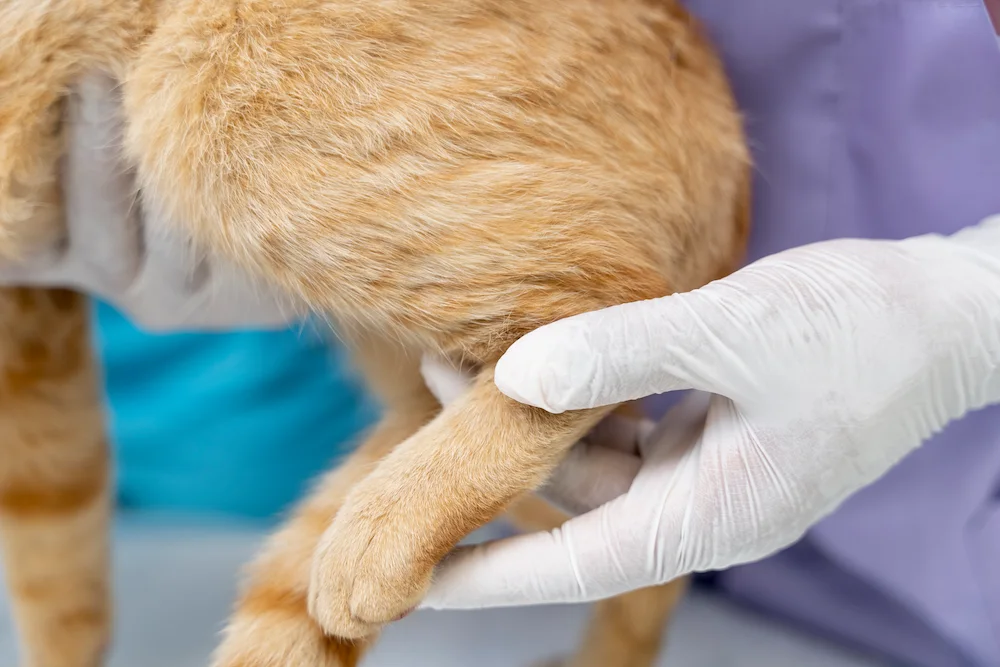
Dr. Megan begins with a conversation about your cat’s history, their arthritis diagnosis, current medications, and the behavioral and physical changes you have noticed. The hands-on evaluation is gentle and paced entirely by the cat. Arthritic cats often have specific areas of heightened sensitivity, and Dr. Megan works carefully around those while building toward corrections.
Adjustments for arthritic cats use very low force adapted to feline anatomy and the individual cat’s condition that day. Most cats tolerate the work well once they understand that the contact is gentle and consistent, and many become noticeably relaxed partway through the session. You will leave with home observation guidance and a recommended follow-up schedule based on what was found.
How Often Do Arthritic Cats Need Chiropractic Care?
For most arthritic cats, an initial phase of visits every three to four weeks helps work through the accumulated restrictions and establish a good baseline. Once the cat is stable and maintaining well between visits, many shift to monthly or every-six-week maintenance appointments.
Senior cats with significant arthritis tend to do best with consistent, ongoing care rather than sporadic visits, because the arthritic process continues and the restrictions it drives need regular management. You can read about outcomes from arthritic and senior cats we have worked with on our testimonials page, including cats whose owners were amazed by how much comfort and mobility returned with consistent chiropractic care.
Simple Home Changes That Help Arthritic Cats
- Add steps or ramps to favorite spots like the bed, couch, or window perch.
- Use a low-entry litter box with at least one side cut down for easy access.
- Keep food, water, and litter on one level so your cat does not need stairs to reach them.
- Offer soft, warm bedding away from drafts.
- Help with grooming and nail trims, since arthritic cats often cannot reach their back or keep nails worn down.
- Keep your cat at a healthy weight, which reduces load on sore joints.
Serving Arthritic Cat Owners Across Charlotte, NC
Axiom Animal Chiropractic is located at 1726 E 7th St in Charlotte, NC. We see cats from throughout Mecklenburg County and the greater Charlotte metro area, including Dilworth, NoDa, Plaza Midwood, SouthPark, Ballantyne, Pineville, and surrounding communities. Dr. Megan Hullihen is a Doctor of Chiropractic from Palmer College of Chiropractic with specialized animal chiropractic training and extensive experience working with senior and arthritic cats.
If your cat has been diagnosed with arthritis or is showing signs that something has been changing in how they move and feel, reach out to schedule a consultation. Book at charlotteanimalchiropractor.com/contact or call us at (704) 469-4772.
Axiom Animal Chiropractic, led by Dr. Megan Hullihen, specializes in Gonstead-based animal chiropractic care for pets and performance animals throughout Charlotte, NC. Our precise, gentle adjustments restore spinal mobility and nervous system function, helping animals move comfortably without medications or surgery. From senior pets with arthritis to competition horses seeking peak performance, we create customized care plans addressing each animal’s unique needs.
Visit our main website to learn more about our approach and services. Schedule a consultation to discover how animal chiropractic can improve your pet’s quality of life.