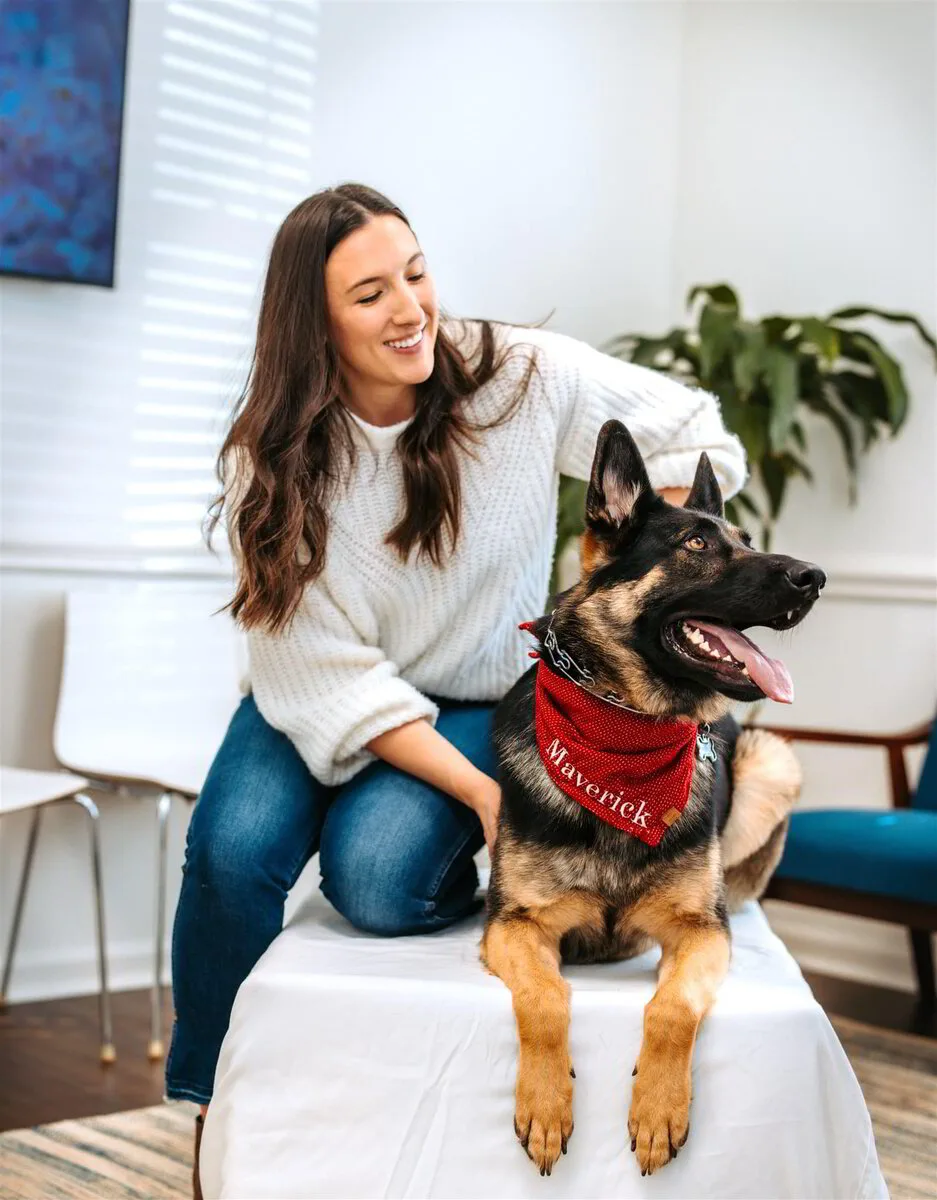
German Shepherds are one of the most physically capable and hardworking breeds in the world, and they are also one of the most predisposed to spinal and hip problems. Chiropractic care may help by restoring motion to restricted areas of the spine and pelvis, easing the compensation patterns that build up around hip dysplasia, lumbosacral strain, and age-related stiffness. It works best alongside regular veterinary care, not in place of it.
At Axiom Animal Chiropractic in Charlotte, NC, German Shepherds are among the dogs we see most often. The combination of breed-specific structural vulnerabilities and the demanding lives many of them lead makes regular chiropractic care a natural fit for this breed. Whether your GSD is a working dog, a sport competitor, or a beloved family companion, their spine deserves the same attention you give the rest of their health.
Why German Shepherds Are Prone to Spinal and Hip Problems
The German Shepherd’s conformation, particularly the angulated rear end that has become more pronounced in certain lines through decades of selective breeding, places significant mechanical stress on the lumbar spine, sacrum, and hip joints. The rear legs of a highly angulated GSD sit in a position that requires continuous muscular effort to maintain. That effort translates to chronic tension in the muscles that support the lower back and pelvis.
Over time, that tension may contribute to vertebral subluxations in the lumbar and sacral regions that compound whatever joint issues the dog is developing. German Shepherds are already predisposed to hip dysplasia, degenerative myelopathy, and lumbosacral stenosis. When spinal restrictions develop on top of those predispositions, the dog’s overall pain load can increase significantly.
Working and sport GSDs face additional demands. Police dogs, search and rescue dogs, Schutzhund competitors, and agility dogs ask their bodies to perform at a high level repeatedly, which can speed up the rate at which spinal restrictions develop. Even family GSDs who hike, run, and play hard put consistent physical demand on a spine that already carries some inherent vulnerability.
Common Conditions in German Shepherds That Chiropractic Can Help With
German Shepherd owners bring their dogs to us for a range of conditions, and several of them have a significant spinal component that may respond well to chiropractic care.
Hip Dysplasia
Hip dysplasia is extremely common in GSDs. The hip joint itself is a structural problem that chiropractic does not change. However, the spinal compensation patterns that develop as the dog favors the affected hip create secondary restrictions throughout the lumbar spine, pelvis, and often the thoracic region.
Correcting those restrictions may help reduce the secondary pain load and help the dog function more comfortably within their diagnosis. If you are unsure whether the hips or elbows are the problem, our post on hip vs. elbow dysplasia in dogs explains how to tell.
Lower Back and Lumbosacral Pain
The lumbosacral junction, where the lumbar spine meets the sacrum, is a high-stress area in GSDs that is prone to developing significant restrictions. Dogs with lumbosacral issues often have difficulty rising, may show weakness or instability in the hind end, and sometimes become reluctant to use stairs or jump.
Chiropractic adjustments to this region may produce meaningful improvement in dogs where lumbosacral restriction is a primary driver of their symptoms. Because German Shepherds can also develop disc disease in this area, any sudden or worsening weakness should be checked by your vet first. Our post on bulging vs. herniated discs in dogs explains what can happen in the spine.
Degenerative Myelopathy Support
Degenerative myelopathy (DM) is a progressive neurological condition common in GSDs for which there is no cure. A DNA test can show whether a dog carries the gene mutation linked to DM, but a diagnosis requires a full veterinary neurological workup. Chiropractic care does not treat DM or slow its progression.
For dogs in the earlier stages, keeping the spine as free of additional restriction as possible may help them stay more comfortable and mobile for as long as possible. We are always honest with owners about what chiropractic can and cannot do in this context.
General Back Pain and Stiffness
Many GSDs develop back pain and stiffness in middle age that their owners attribute to simply getting older. Aging does bring structural changes, but part of what looks like “just getting old” in a German Shepherd can be accumulated spinal restriction that is very much addressable. Many dogs who seemed to be slowing down surprise their owners with how much mobility they regain once those restrictions are worked through.
What to Watch for in Your German Shepherd
GSDs are stoic dogs who tend to push through discomfort rather than show it. Watch for these patterns that often indicate spinal involvement:
- A sinking or swaying in the rear end when standing or walking
- Difficulty rising from a lying position, particularly on hard floors
- Reluctance to jump into the car or onto furniture they used to access easily
- Stiffness after rest that loosens with movement but returns after exercise
- A change in how the dog carries their tail, lower than usual or off to one side
- Sensitivity along the lower back when touched or when the hind end is handled
- A progressive shortening of the rear stride
- Behavioral changes like reduced enthusiasm for work or play that used to motivate them
When to See Your Vet First
Some signs point to a neurological or medical problem that needs a veterinarian before chiropractic care. Call your vet promptly if your German Shepherd shows:
- Knuckling over on the back paws, scuffing the toenails, or crossing the hind legs
- Sudden weakness, wobbling, or inability to stand
- Crying out when moving or when the back is touched
- Loss of bladder or bowel control
- Lameness that appears suddenly or comes with swelling
Once serious causes are ruled out, chiropractic can be a helpful part of the plan your vet recommends.
Chiropractic as Part of a GSD’s Long-Term Health Plan
For German Shepherds, we generally recommend not waiting for obvious symptoms before starting chiropractic care. Given the breed’s structural predispositions, proactive spinal maintenance starting in young adulthood may lead to better long-term outcomes than waiting until restrictions are well established and the dog is already struggling.
For working and sport GSDs, regular chiropractic care during active seasons helps manage the structural stress that high-demand work creates. For family GSDs, consistent maintenance visits keep the spine functioning well and catch developing restrictions before they become significant problems.
Dr. Megan coordinates with your veterinarian and adapts every care plan to the individual dog in front of her. She asks that you bring your GSD’s veterinary records to the first visit so she has a complete picture of their health history and any diagnoses that should inform her approach. Learn more about canine chiropractic care at Axiom Animal Chiropractic.
Frequently Asked Questions
Is chiropractic safe for a German Shepherd with hip dysplasia?
Yes, when the adjustments are adapted to the dog. Dr. Megan works around the affected hip and focuses on the spinal and pelvic restrictions that build up from compensation, using gentle, specific contacts.
At what age should a German Shepherd start chiropractic care?
Many owners start in young adulthood, around the time a GSD finishes growing and becomes more active. Earlier checks make sense after a fall, a rough play injury, or if you notice uneven movement.
How often does a German Shepherd need adjustments?
It depends on age, activity, and condition. Most dogs start with a few closer-together visits, then move to maintenance every few weeks to every few months based on how they respond.
Serving German Shepherd Owners Across Charlotte, NC
Axiom Animal Chiropractic is located at 1726 E 7th St in Charlotte, NC. We see German Shepherds and dogs of all breeds from throughout the Charlotte metro area, including Huntersville, Mooresville, Concord, Matthews, Mint Hill, Indian Trail, and surrounding communities. Read about patient outcomes on our testimonials page, and when you’re ready to book, reach out at charlotteanimalchiropractor.com/contact or call us at (704) 469-4772.
Axiom Animal Chiropractic, led by Dr. Megan Hullihen, specializes in Gonstead-based animal chiropractic care for pets and performance animals throughout Charlotte, NC. Our precise, gentle adjustments restore spinal mobility and nervous system function, helping animals move comfortably without medications or surgery. From senior pets with arthritis to competition horses seeking peak performance, we create customized care plans addressing each animal’s unique needs.
Visit our main website to learn more about our approach and services. Schedule a consultation to discover how animal chiropractic can improve your pet’s quality of life.