
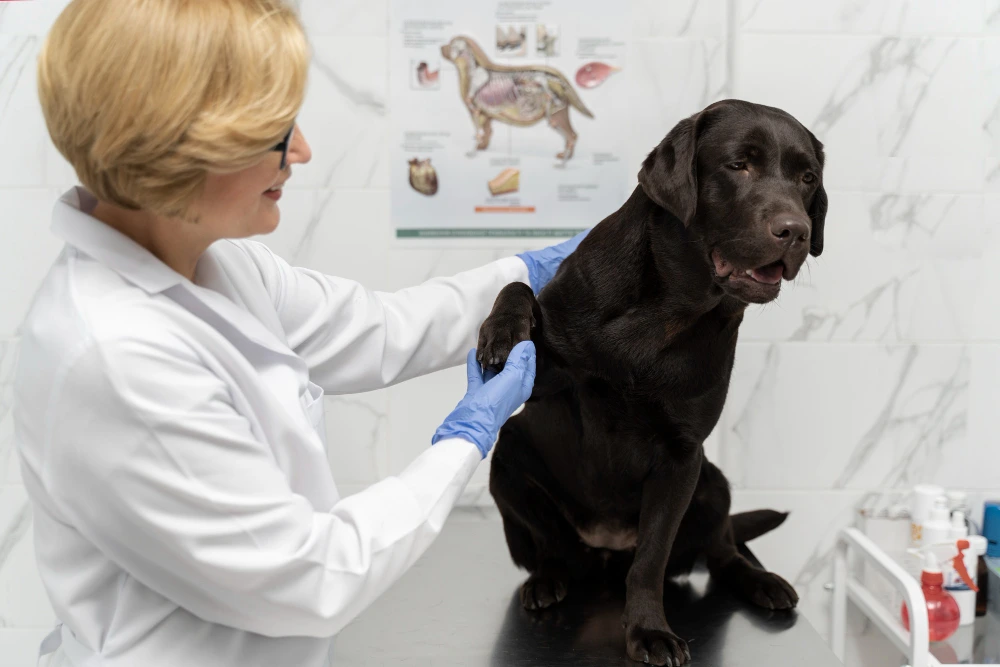
A CCL injury is a tear in the cranial cruciate ligament of the knee, and it usually causes sudden hind-leg lameness after activity. Hip dysplasia is a developmental malformation of the hip joint that tends to cause gradual stiffness and a swaying gait over time. Both affect the back legs and are easy to confuse, but they involve different joints, different causes, and different timelines.
Why These Two Get Mixed Up
Both conditions show up as hind-end trouble. A limp, reluctance to jump, difficulty rising, trouble on stairs. From the outside, an owner watching their dog slow down can’t always tell whether the problem is the hip or the knee.
The confusion matters because the two conditions call for different management. Getting the right picture early helps you and your veterinarian make better decisions about treatment and support.
At our Charlotte practice, we regularly see dogs where the owner assumed one joint was the culprit when the other was actually driving the problem, or where both were involved at once.
CCL Injury: The Knee Problem
The cranial cruciate ligament sits inside the knee and keeps the joint stable during movement. It’s the dog equivalent of the ACL in people. When it tears, the knee becomes unstable, which is painful and quickly leads to inflammation.
CCL injuries often happen suddenly, during a hard turn, a jump, or a slip. But they can also develop gradually as the ligament weakens over time before finally giving way. Common signs include:
- Sudden lameness in one back leg, sometimes after play or exercise
- Holding the affected leg up or toe-touching the ground
- Swelling around the knee joint
- Sitting with the affected leg stuck out to the side
- A clicking sound when walking, in some cases
CCL injuries usually affect one leg at first, though dogs that tear one often tear the other later because of the extra load placed on the good leg.
Hip Dysplasia: The Joint Malformation
Hip dysplasia is different at its root. Instead of a torn ligament, the ball-and-socket structure of the hip simply didn’t form correctly during growth. That looseness leads to abnormal wear, inflammation, and eventually arthritis. You can read more in our detailed post on hip dysplasia in dogs.
Because it’s developmental, hip dysplasia usually comes on gradually rather than in a single dramatic moment. Signs tend to include:
- A swaying or “bunny hopping” gait, especially when running
- Stiffness that’s worse after rest and eases with movement
- Difficulty rising from a lying position
- Muscle loss in the back legs over time
- Reluctance to jump or climb stairs
Larger breeds like German Shepherds, Golden Retrievers, and Labradors are commonly affected, though it can appear in any dog.
The Key Differences at a Glance
A few patterns help separate the two. CCL injuries often come on suddenly and affect the knee, with the dog frequently holding the leg up. Hip dysplasia tends to develop slowly, affects the hip, and shows up as that telltale swaying gait and difficulty getting up.
Timing is one of the biggest clues. A dog that was fine yesterday and severely lame today is more likely dealing with an acute injury like a CCL tear. A dog that has slowly gotten stiffer over months is more likely dealing with something developmental like hip dysplasia.
Why Compensation Complicates Things
Here’s where it gets tricky. When a dog favors a sore knee or hip, it shifts weight to the other legs and changes how the whole body moves. Over time, this altered gait creates secondary tension and restriction in the spine and surrounding muscles. A dog protecting a bad hip may develop back tightness, and a dog protecting a torn CCL may overload the opposite leg.
This is why looking only at the obviously affected joint can miss part of the picture. The body works as a connected system, and the original problem often creates knock-on effects elsewhere.
Where Chiropractic Care Fits In
Chiropractic care does not repair a torn ligament or reshape a malformed hip. Those need veterinary diagnosis and, in many cases, medical or surgical treatment. What chiropractic care can do is help with the compensation patterns that build up around these conditions.
Gentle adjustments can help restore more even movement, ease the secondary restrictions that develop from an altered gait, and support overall mobility. For a dog recovering from CCL surgery, or one managing hip dysplasia long-term, this kind of support can be a meaningful part of keeping them comfortable.
We always coordinate with your dog’s veterinarian on this. If your dog hasn’t been formally diagnosed yet, that’s the right first step before starting any chiropractic plan. Chiropractic care works alongside veterinary treatment, never in place of it.
What We Look At
When a dog comes in with hind-end trouble, we start by watching how they move, how they rise, and how they distribute weight. We gently assess range of motion and check for the compensation patterns that so often accompany knee and hip problems. From there, we build a plan around the dog’s specific build, age, and condition.
If you’re not sure whether your dog’s limp is coming from the knee or the hip, a hands-on evaluation combined with veterinary input can help clarify things.
Want help getting your dog moving comfortably again? Schedule a consultation or call us at (704) 469-4772. Learn more about our canine chiropractic services in Charlotte, NC.