
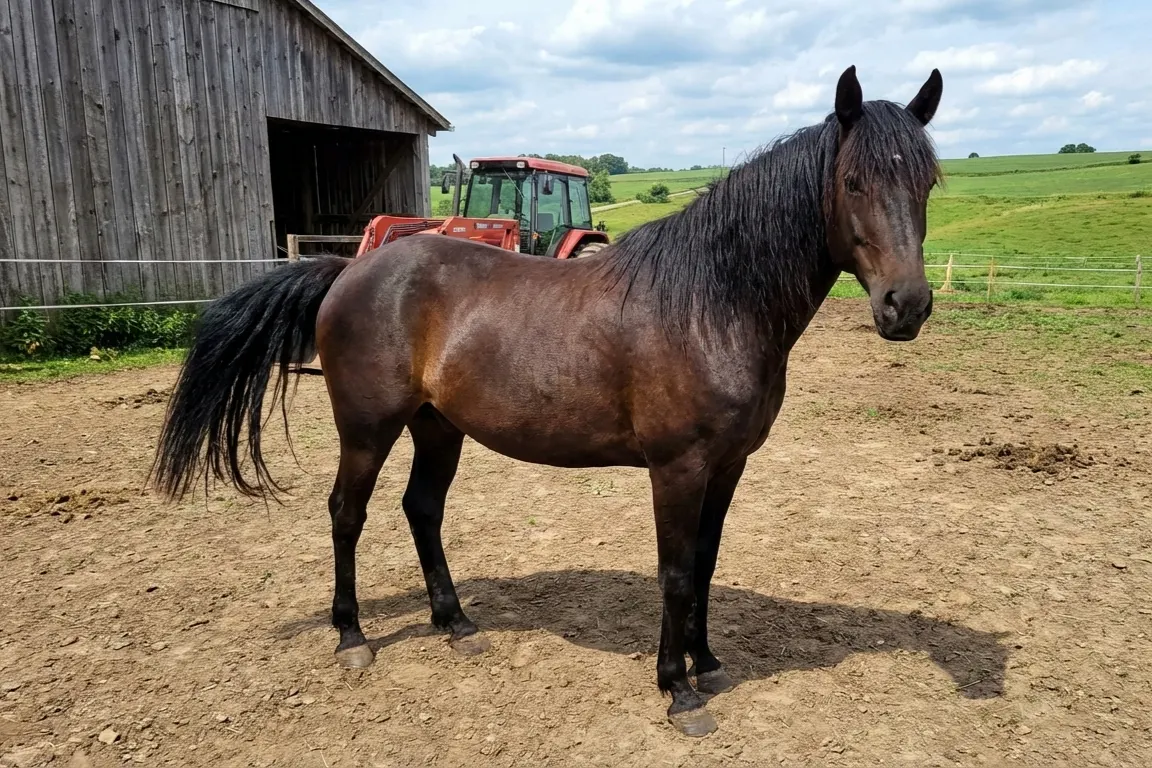
Kissing spine is a condition where the bony projections along a horse’s spine sit too close together and rub or press against each other, causing pain and stiffness. It commonly affects performance horses and can show up as back pain, resistance under saddle, or behavior changes. Chiropractic care cannot reshape the bones, but it can help with the muscle tension and movement restrictions that develop around the condition.
What Kissing Spine Actually Is
Along the top of a horse’s spine, each vertebra has an upward bony projection called a dorsal spinous process. In a healthy back, these projections have space between them. With kissing spine, formally called impinging dorsal spinous processes, those projections are positioned too close together and can touch, overlap, or press on one another.
That contact causes pain, inflammation, and stiffness, particularly in the area under and just behind the saddle. It’s most often found in the mid-back, which is exactly where the rider’s weight sits.
Which Horses Are Most Affected
Kissing spine turns up across many breeds and disciplines, but it’s especially common in performance horses. Thoroughbreds seem to be over-represented, and the condition is frequently found in horses doing demanding work like dressage, jumping, and other athletic disciplines.
Some horses have the bony changes without ever showing obvious symptoms, while others become quite uncomfortable. This variability is part of what makes kissing spine tricky to recognize.
Signs to Watch For
Because horses can’t tell us where it hurts, kissing spine often shows up as changes in behavior or performance rather than obvious lameness. Owners and trainers in the Charlotte-area equestrian community often notice:
- Sensitivity or flinching when the back is groomed or the saddle is placed
- Resistance to being saddled or girthed
- Bucking, rearing, or “cold-backed” behavior at the start of a ride
- Reluctance to move forward, collect, or engage the hindquarters
- Difficulty with transitions or a hollow, tense topline
- A general drop in performance or willingness
These signs are easy to misread as training problems or a horse simply being difficult. But behavior changes under saddle are often the body’s way of signaling discomfort.
Why It Gets Missed
Here’s the thing about kissing spine. Because the symptoms so often look like attitude or training resistance, horses can be labeled as stubborn or badly behaved when they’re actually in pain. A horse that bucks at the girth or refuses to collect isn’t necessarily being difficult. It may be telling you its back hurts.
This is why a thorough look at the whole horse matters when performance or behavior changes. Saddle fit, spinal health, and training approach all interact, and our post on saddle fit and back pain covers a closely related piece of this puzzle.
How Kissing Spine Is Diagnosed
A definitive diagnosis of kissing spine requires veterinary imaging, usually x-rays, sometimes combined with other diagnostics. This is firmly in the veterinarian’s domain, and any horse with suspected back pain should be evaluated by a vet. Kissing spine is a structural condition, and understanding its severity guides the whole management plan.
Where Chiropractic Care Fits In
Chiropractic care does not change the bony structure of the spine, and it isn’t a cure for kissing spine. What it can do is help with the secondary problems that build up around the condition.
When a horse has back pain, it changes how it moves. It braces, hollows the back, and recruits muscles in ways that create tension and restriction elsewhere. Over time, this compensation can become its own source of discomfort. Gentle chiropractic adjustments can help address these movement restrictions and muscle tension patterns, supporting better mobility and comfort as part of a broader management plan.
The most effective approach to kissing spine is usually a team one. Veterinary treatment addresses the underlying condition, and supportive care like chiropractic work, appropriate saddle fitting, and a thoughtful conditioning program all contribute to keeping the horse comfortable and working.
Mobile Care That Fits Your Barn
Because horses cannot come to our clinic, all equine chiropractic visits are mobile. We travel to your stable or facility in the Charlotte area, which fits naturally around training and turnout schedules. That also lets us see the horse in its own environment, which can be useful context.
We coordinate with your horse’s veterinarian, trainer, and farrier as needed, since spinal health rarely exists in isolation from shoeing, saddle fit, and training.
The Bigger Picture
If your horse has developed unexplained resistance, back sensitivity, or a drop in performance, it’s worth taking seriously rather than pushing through. Back pain doesn’t resolve on its own when the horse keeps working through it, and early attention tends to lead to better outcomes.
Concerned your horse might have back pain? Schedule a mobile visit or call (704) 469-4772. Learn more about our equine chiropractic services for Charlotte-area horses.