
Cats are famous for landing on their feet, but that doesn’t mean a fall leaves the spine unaffected. Even when a cat walks away from a drop without obvious injury, the impact forces travel through the body and can create vertebral subluxations that linger long after the visible drama is over. At Axiom Animal Chiropractic in Charlotte, NC, we see cats whose owners had no idea a fall months or years ago was still affecting how their cat moves today. If your cat has taken a significant tumble and hasn’t quite seemed like themselves since, a chiropractic evaluation is worth considering.
Why Cats Are More Vulnerable to Spinal Injury Than People Assume
The “righting reflex” that allows cats to orient their body mid-fall is genuinely impressive, and it does protect them in important ways. But it has limits. Falls from certain heights, particularly two to four stories where the cat doesn’t have enough time to fully right before impact, can produce significant compressive forces through the spine even when no fractures or obvious injuries occur.
Falls from lower heights, including off countertops, cat trees, or furniture, are actually more common causes of cervical and thoracic restrictions because the cat doesn’t have enough air time to fully prepare for impact. A sudden, unexpected drop onto a hard floor can jar the spine in ways that create subluxations even if the cat shakes it off and walks away normally.
Because cats are so stoic about pain, the aftermath of a fall often goes unnoticed. The cat seems fine. They’re moving around, eating, and behaving mostly normally. But over weeks and months, subtle changes accumulate, and owners start noticing things they can’t quite explain.
Signs Your Cat May Have Spinal Restrictions After a Fall
The signs of post-fall spinal restrictions in cats are often gradual and easy to miss or attribute to other causes. Here are patterns worth paying attention to:
- Reduced flexibility or stiffness that appeared after a known fall
- Changes in how the cat jumps, landing less smoothly or avoiding jumps they used to make easily
- Sensitivity or flinching when touched along the back, neck, or shoulders
- A change in posture, such as a rounded back or head held differently than before
- Reduced grooming, particularly in areas the cat now has difficulty reaching
- Withdrawal from play or less interest in climbing and exploring
- Occasional limping or uneven gait that comes and goes
- General quietness or reduced activity that developed gradually after a fall
Any of these signs following a fall is worth a veterinary visit first to rule out fractures, internal injuries, or other conditions that need medical attention. Once those are cleared, a chiropractic evaluation makes sense if the cat still isn’t moving or behaving the way they did before.
What Happens to the Spine During a Fall
When a cat lands from a fall, the impact sends compressive and shear forces through the spine. The vertebrae absorb that force, and in doing so, one or more may shift slightly out of their normal alignment. These subluxations create pressure on the surrounding nerves, which triggers a protective muscle response. The muscles tighten around the affected area to stabilize it, which further restricts movement and contributes to the stiffness and behavioral changes the cat shows afterward.
This process can happen at any level of the spine. Falls that land front-end heavy tend to create cervical and thoracic restrictions. Falls that land more evenly or on the hindquarters tend to affect the lumbar and sacral regions. In some cases, restrictions develop at multiple levels from a single impact.
Without correction, these restrictions don’t simply resolve over time. The muscles adapt to holding the compensation pattern, the surrounding joints begin to experience uneven wear, and what started as an acute post-fall response becomes a chronic structural issue.
How Chiropractic Addresses Post-Fall Spinal Restrictions in Cats
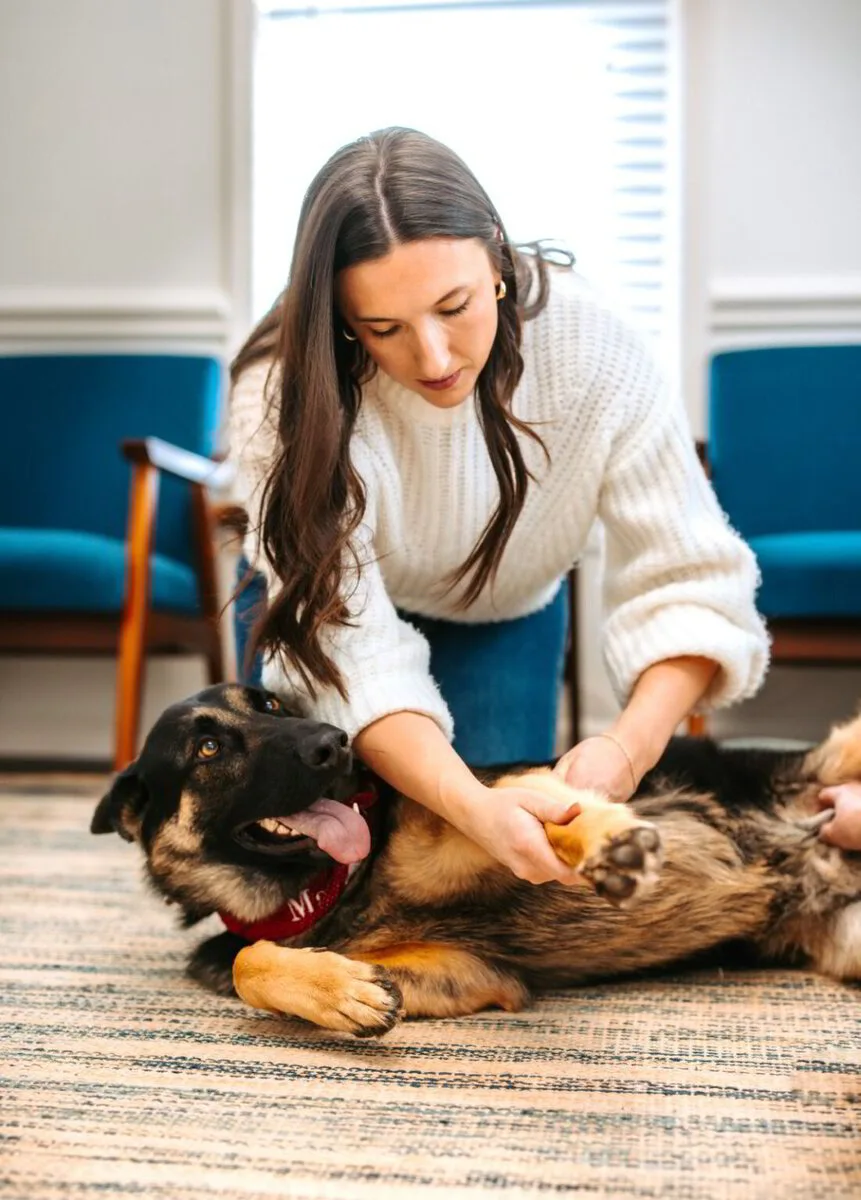
A chiropractic evaluation after a fall involves a thorough hands-on assessment of the entire spine, not just the area that seems most affected. Dr. Megan evaluates posture, flexibility, and how each spinal segment responds to gentle motion testing. She identifies where restrictions are present and how significant they are before making any adjustments.
Adjustments for cats are precise and low-force, adapted to feline anatomy and the individual cat’s tolerance that day. The cervical spine in particular requires a very careful, specific approach, and Dr. Megan’s training and experience working with cats means she knows how to apply the right amount of force in exactly the right place.
For cats dealing with post-fall restrictions, the response to chiropractic care is often noticeable relatively quickly. Many cats show improved flexibility and comfort within one to three visits. Some show changes even within the first session. The timeline depends on how long the restrictions have been in place and how significant they are.
How Soon After a Fall Should You Seek Chiropractic Care?
If your cat has just had a fall, the first step is always a veterinary evaluation to rule out acute injury. Once your vet has cleared your cat and confirmed there are no fractures, dislocations, or internal injuries that need immediate medical management, chiropractic care can begin.
In general, sooner is better. A restriction that’s been in place for a week is easier to correct than one that’s been held for six months with significant muscular adaptation around it. If you know your cat took a fall and something has been subtly off ever since, don’t wait for the signs to become more obvious before seeking an evaluation.
That said, it’s never too late to address a post-fall restriction. We regularly work with cats whose owners didn’t connect the dots between a fall years earlier and the mobility changes they’re now seeing. Older restrictions take more time to work through, but they’re still worth addressing. Learn more about our approach to feline chiropractic care in Charlotte.
What the Visit Looks Like for a Post-Fall Cat
Our clinic space in Charlotte is kept calm and low-stimulation, which helps cats who are already dealing with discomfort or stress. We recommend bringing your cat in their usual carrier so familiar smells are present throughout the visit. Dr. Megan works at the cat’s pace from the start, never rushing and always reading the cat’s comfort level before proceeding with any part of the evaluation or adjustment.
After the visit, you’ll receive specific guidance on what to watch for at home and a recommended follow-up schedule based on what was found. You can also read about outcomes from some of the cats we’ve worked with on our testimonials page, including cats whose owners were amazed by how much mobility returned after chiropractic care.
Serving Cat Owners Across Charlotte, NC
Axiom Animal Chiropractic is located at 1726 E 7th St in Charlotte, NC. We see cats from throughout Mecklenburg County and the greater Charlotte metro, including Dilworth, NoDa, Plaza Midwood, SouthPark, Pineville, Ballantyne, and surrounding areas. Dr. Megan Hullihen is a Doctor of Chiropractic from Palmer College of Chiropractic with specialized animal chiropractic training and experience working with cats at every stage of life and recovery.
If your cat has had a fall and hasn’t been quite right since, we’d be glad to take a look. Book a consultation at charlotteanimalchiropractor.com/contact or call us at (704) 469-4772.